

Table of contents
- What Is Redirected Aggression?
- Is Redirected Aggression Preventable?
- Step 0: Follow Jackson’s Cat Introduction Protocol
- Step 1: Total Separation
- Step 2: Scent Swapping
- Step 3: Site Swapping
- Step 4: Blind Dinner Dates
- Step 5: Gradual Visual Exposure
- Step 6: Improving Eye Contact
- Step 7: Playing Through A Barrier – The Crunchy Cube
- Step 8: Re-introduction Without Barriers
- Step 9: Controlled Progression – Working Towards Coexistence
- Products & Supplements: What Worked and What Didn’t
- My Story
My cats lived in perfect harmony for six years before the scent of another cat turned them into mortal enemies in an instant. Before that, they were inseparable – they played together, groomed each other, and slept curled up together. Then, in an instant, everything changed.
A single encounter with the scent of an unfamiliar cat sent one of them into a frenzy, triggering an aggressive outburst that left them both terrified of each other. What started as fear and confusion quickly escalated into full-blown hostility, to the point where they could no longer be in the same room.
What is Redirected Aggression?
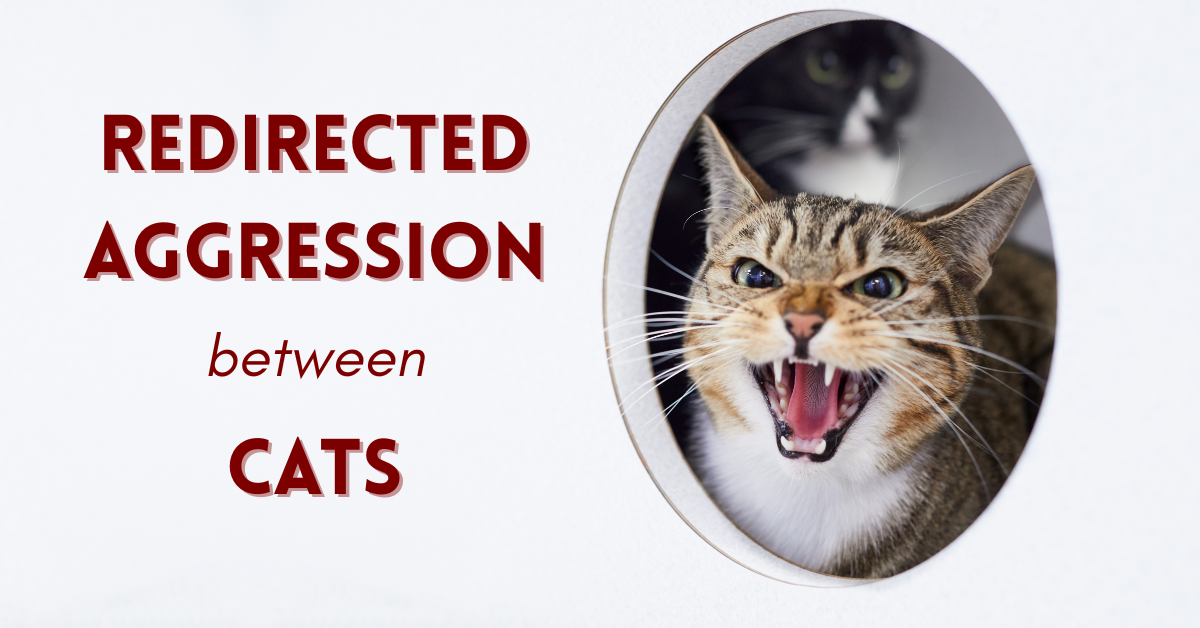
What my cats experienced was redirected aggression (RA), a sudden and intense reaction where a cat, unable to direct its fear or frustration at the actual source, lashes out at whatever is nearby, whether that be another pet or person.
If your cats have experienced redirected aggression, you’re not alone. Upon researching the phenomenon, I was devastated to learn that some people resort to rehoming one of their cats. I’m here to tell you that doesn’t have to be the case – you can get your cats back on good terms.
It just takes a lot of time, patience, and structured reintroduction to rebuild trust. No matter how close your cats once were, you must be consistent and diligent about gradually rebuilding their trust for one another according to a cat behaviorist-approved plan.
Can you prevent redirected aggression?
Redirected aggression is entirely random, and there’s no foolproof way to prevent it either. It can happen indoors or outdoors from seeing or smelling another animal or hearing a loud noise. Does that mean you should forbid your cats from looking out of a window? No.
If you read my story, you’ll understand exactly how unpredictable RA is despite years of experiences that prove otherwise. Don’t live your life in fear of RA, and don’t compromise your cat’s quality of life in an attempt to prevent it either.
RA is not very common, but after hearing from others, it’s not exactly rare either. The best you can do is be prepared to handle RA properly if it ever happens.
The only exception that comes to mind where redirected aggression is preventable is when a cat returns home from the vet and the other resident cat is triggered by the foreign scents.
Knowing what I know now, it’s a good idea to keep your cats separated for at least a day after a vet visit and carefully re-introduce them.
Step 0: Follow Jackson Galaxy’s Cat Introduction Protocol
If your cats are experiencing redirected aggression, it’s crucial to follow Jackson Galaxy’s Cat Introduction protocol. Even if they’ve been inseparable for years, a single incident of redirected aggression can turn them into enemies, requiring a full reintroduction as if they were meeting for the first time.
I’m sharing my personal experience, along with valuable insights and lessons learned, to help you navigate this process. Below, you’ll find links to Jackson Galaxy’s free resources that provide an overview of his proven method.
- Article: The Do’s & Don’ts of Introducing Cats
- Video: The Do’s & Don’ts of Introducing Cats
- Video: How to Deal with Cat Fights
- Video: How to Introduce Cats
Step 1: Total Separation
After the last and most brutal cat fight, I completely separated my cats (something I should have done after the first cat fight but did not do out of ignorance). I made sure they had no visual access to each other to ensure they could effectively decompress.
Set Up Separate Base Camps
The cats were going to be living in separate areas of the house for the foreseeable future, so it was important to make sure that each cat felt at home in their designated space. Moosh would remain downstairs while Oliver moved upstairs. All the existing cat supplies were downstairs, so it was time to “catify” upstairs.
Beyond adding the essentials like litter boxes, food, and water, I purchased a tall cat tree, cat hammock, and cat toys. Cats need vertical spaces for enrichment, and the Mau cat tree did exactly that. The suction cup hammock was a great addition for the window as it gave Oliver a warm place to perch and observe birds.
If I wasn’t renting this home, I would have added cat shelves, but there was only so much damage I could do to the walls. If you’re going through this in a home that you own, you should get creative with the “catification” process!
Decompression Stage
After the hell that they went through with the last fight, it was very important that the cats have a few days to decompress. I did not do anything in this stage other than let them rest and get comfortable with their new living arrangements.
I’d spend time with each cat separately, making sure I changed clothes and washed my hands before interacting with the other cat. I didn’t want to make the cats anxious by approaching them with the strong scent of the other cat.
It’s not as tedious as it sounds. It was as simple as putting on a sweater when interacting with one cat and then taking it off when interacting with the other. I’d put a towel or blanket on my lap to reduce the intensity of their scent on my pants if they wanted to cuddle.
Do NOT Free-Feed
In the very beginning of Jackson’s guide, he stresses the importance of NOT free-feeding. Instead, your cats need to be on a consistent meal schedule to stay food motivated and set the stage for the steps moving forward.
Jackson describes this as the foundation of a successful reintroduction, and he’s absolutely right. Cats thrive on routine, so establishing a meal routine is the first and crucial step toward rebuilding trust for one another during shared meals in step 4.
Start A Daily Log
I highly recommend keeping a daily log of everything you do in the reintroduction process moving forward. Why? Because it’s going to be a long journey and it’s easy to feel discouraged or hopeless at times. Having something to look back on helps you celebrate incremental progress and stay motivated.
Here’s an example of what my daily log looked like:
Date: 1/12/2026
Checklist:
- Scent swap
- Site swap
Notes: Oliver hissed when he smelled Moosh on his blanket, but still napped on the blanket.
Step 2: Scent Swapping
Scent swapping is a behavioral tool used to reduce tension between cats, especially when redirected aggression has occurred. Cats rely heavily on scent to recognize safety, familiarity, and group identity. Scent swapping helps rebuild the sense of shared group scent and reduces that perception of “stranger danger.”
- Use soft materials: Rub a clean cloth on one cat and place it near the other cat, allowing them to approach and investigate it on their own terms. This gives them the chance to become familiar with the scent gradually, in a safe and non-threatening way.
- Swap bedding: Exchange blankets, beds, or toys that each cat has used so their scents mingle naturally.
- Controlled exchange: Rub both cats with the same cloth in succession so they begin to share a blended group scent again.
If Cat 1 hisses at the scent of Cat 2, that means the scent is still too strong and triggering. To ease this, place the scented cloth from Cat 2 inside a towel or blanket that already carries a neutral smell or Cat 1’s own scent. This “dilutes” the intensity of Cat 2’s odor, allowing Cat 1 to build tolerance gradually in a less overwhelming way.
Step 3: Site Swapping
After your cats have become 100% comfortable with scent swapping, the next step is site swapping. This phase allows each cat to explore and adjust to areas of the home that smell like the other cat without ever coming into direct contact.
To prevent any accidental encounters, barriers such as baby gates, double doors, or draft blockers should be used. These prevent cats from making contact through door gaps while still allowing scent to travel. I highly recommend non-adhesive door draft blockers or stuffing rolled towels to block the door gap.
When I was in this stage, I’d place Oliver in my bedroom, close the door, and coax Moosh upstairs with treats. Once Moosh was upstairs and in my office, I’d close the office door and then open the bedroom door for Oliver to go downstairs.
Over time, confidence should build naturally. You can bribe them to explore with treats, but never force exploration. Let your cats establish a sense of security at their own pace.
There’s no strict time limit for how long a cat can remain in the swapped territory, as long as they are returned to their home base by the end of the day. Allow them to explore for as long as they’re comfortable, then guide them back to their familiar space.
It’s common for cats to occasionally display puffed tails, tense posture, cautious movements, and even occasional hissing when site-swapped into areas filled with the other cat’s scent, especially on strongly marked objects like scratching posts or cat trees.
If the reaction becomes intense or prolonged, it’s best to return to the scent swapping phase before trying site swapping again. With repeated exposure, these reactions typically lessen as the cat learns the environment is safe.
There’s no strict time limit for how long a cat can remain in the swapped territory, as long as they are returned to their home base by the end of the day. Allow them to explore for as long as they’re comfortable, then guide them back to their familiar space.
The site swapping stage can last weeks or even months. There’s no fixed timeline – it depends entirely on when your cats are consistently calm and comfortable in each other’s spaces.
Moving to any new step or phase of reintroduction should only happen when your cats show absolutely no signs of stress in their existing stage.
Step 4: Blind Dinner Dates
Remember how Jackson’s guide stressed the importance of not free-feeding? It’s very important that your cats are on a consistent meal schedule to stay food motivated for this step: blind dinner dates. Jackson refers to this as the “other side of the door” feeding ritual.
The purpose is to establish positive associations between each cat by feeding them on opposite sides of a closed door. Continue to site swap throughout this stage.
If you were using door draft stoppers to prevent visual contact in the site-swapping stage, remove them during meal time, but put them back afterwards. There shouldn’t be any direct visual exposure during this stage beyond the exposed door gap.
You start by putting their food bowls at a safe distance from the door and gradually move them closer over time. Once they’re done eating, you immediately separate them to prevent any negative interactions from happening in the absence of food.
What happens if my cat gets scared?
When I tried this for the first time, Moosh hissed and ran downstairs. So for the next meal, I rolled up a towel and covered the door gap. I mentioned that pheromone diffusers were not helpful in my situation, but I used feliway spray on the towels in case it had any benefit. It didn’t seem to make a difference, but it was worth trying.
For the next few weeks, I simultaneously moved their food closer while reducing the length of the towel. Eventually, it got to the point where they could be fed directly on opposite sides of the door without a towel.
Then I started changing their positions so Oliver could eat on the side that Moosh usually ate on. This helped me observe the behavior of both cats in different feeding spots so I could determine both of their comfort levels.
I used their auto-feeders on both sides of the door because the sound was a great cue to get them into position. I obviously turned off their auto-feeders and used the manual feed mode so I could be physically present to watch them and give each cat access to their feeding space.
After a month, they were at the point where they could eat on opposite sides of the door without any signs of stress, tension, or hesitation. In fact there were even some friendly interactions, which was a sign they were ready to start the next phase.
The length of each phase depends on your cats. Be patient and only move forward to the next step when both of your cats are consistently relaxed in their current phase.
Step 5: Gradual Visual Exposure
The next step is getting them acclimated to gradual visual exposure by feeding the cats with a buffer barrier in place. In this case, a tall baby gate was used, but some people prefer replacing an existing door with a screen door.
It’s unrealistic to expect cats to tolerate full visual access immediately. For this reason, Jackson Galaxy recommends the “Curtain Raising” technique – covering the barrier with a blanket (or in my case, cardboard) and gradually increasing visibility over time.
I cut up some Amazon boxes and secured the cardboard panels to the baby gate with zip ties. The goal was to gradually create more visual exposure by sliding up the cardboard pieces and eventually removing them in small increments.
For the first week, no pieces were moved at all. Once the cats were comfortable eating on either side of the barrier, panels were slowly raised by a few inches every other day. It’s important to make adjustments before feeding begins, since the sound of moving cardboard could startle the cats.
After about three weeks, smaller pieces of cardboard were removed entirely. Larger panels were cut in half and reattached, making it easier to reduce coverage gradually. The final goal is to phase out the cardboard completely, but progress depends entirely on the cats’ comfort levels.
This stage works the same way as the earlier “blind dinner dates.” Eating together creates a positive association, but once meals are finished, the cats are separated again to avoid conflict outside of mealtime. Each cat is then returned to their own territory.
To avoid food-related tension, the cat who ate slower was given a head start before the other cat was allowed to approach. This prevented the cat who ate faster from finishing his food early and attempting to steal the other cat’s food (and subsequently startling them) through the gate. These nuances and adjustments vary based on your cats’ personalities and the type of barrier used.
Just like with the blind dinner dates, feeding positions were occasionally swapped so that each cat became comfortable eating on both sides of the barrier.
Remember that there’s no fixed timeline for how long your cats should spend in each phase. The pace depends entirely on how comfortable and relaxed your cats are in each stage. The most important rule is not to rush.
My cats remained in this phase for well over a month, but despite our best efforts and following Jackson’s guide carefully, there was still tension. Because of this, I deviated from Jackson’s guide to solve the problem which is discussed in step 6.
Step 6: Improving Eye Contact
The final stage in Jackson’s guide is the “Eat, Play, Love” stage where you bring both cats into the same room with no barrier, but keep them actively occupied with food, toys, and affection.
The goal is to repeatedly create “being together = good things happen” so calm co-presence becomes the default.
However, my cats were nowhere near ready for this stage because they were still struggling with visual exposure between a baby gate.
The problem wasn’t just seeing each other – it was eye contact.
Jackson’s guide is a generalized protocol for most cats. My cats were definitely an edge case, so I had to deviate from his guide and work with my cats based on their specific issues.
To improve eye contact, I placed one cat in the catio and the other inside so they could observe each other through the window. I cleaned the glass with a wet rag (no chemicals) and put “cat gogurt” (squeeze treats) on each side of the glass.
This incentivized each cat to look at each other while they licked the treats off the glass simultaneously. Eye contact improved dramatically after repeating this ritual only 4 times.
I continued feeding them between the cardboard covered barrier and was able to remove all remaining cardboard pieces within a week.
The next two weeks passed without any tension – my cats were finally comfortable with total visual exposure.
What if I don’t have a catio?
Not everyone has a catio or the perfect window setup for this eye-contact ritual, and that’s okay. You can still recreate a similar environment indoors.
There isn’t a single universal setup that works for every home, because room layouts, doors, and available surfaces vary.
This is the goal: create a sturdy clear barrier so both cats can see each other without making physical contact.
Focus on the principle, and adapt the execution based on the structure of your space.
Your job is to get creative with the space you do have while maintaining full safety and security.
Here are a few ideas that can work as alternatives:
- A tall plexiglass/acrylic panel temporarily secured in a doorway
- A plexiglass/acrylic panel (cut to size) attached to your existing baby gate
- A clear baby gate stacked in a doorway with a sheet of rigid plastic zip-tied to the front
- A glass storm door (if you have one on an interior of your home)
Just make sure the barrier is:
- Stable
- Fully secure
- Impossible for paws to reach through, around, or under
- Easy to clean (you’ll be wiping treats off it)
If you have indoor cats, do not simply put one cat outside and the other indoors solely to mimic a “window situation.” That adds stress, introduces outdoor variables, and can backfire.
Can I do this without a smooth transparent surface?
You can, but you might lose a finger. Based on my experience, it was dangerous and significantly less effective compared to using a smooth transparent surface.
Before I transitioned to the “window ritual,” here’s what happened when I tried doing this through a baby gate:
Feeding one shared squeeze treat through the gate: The cats didn’t lick in sync and immediately got competitive and hostile attempting to grab or bite the tube away from each other.
Feeding each cat their own squeeze treat on opposite sides of the gate: My husband and I stood on opposite sides of the gate feeding each cat their own treat simultaneously. The cats avoided looking at one another and directed their attention at us instead.
Squeezing treats directly onto the gate bars: This worked slightly better, but the vertical bars acted like visual interference. Their eyes could not meet cleanly and consistently while eating.
If the catio window ritual hadn’t been an option, my next plan would have been to have an acrylic sheet cut to span the full width and half the height of my tall baby gate. I would have secured it directly to the gate, then squeezed treats onto the plexiglass between two vertical bars so both cats could lick from opposite sides while maintaining unobstructed eye contact.
Step 7: Playing Through A Barrier – The Crunchy Cube
At this point, my cats were 100% comfortable with eye contact, complete visual exposure, and even sitting idle on each site of the baby gate in the absence of food.
There was no longer any hostility or tension, but Oliver was interested in playing and Moosh was not.
The next step was to get them accustomed to being near each other without the barrier, but Moosh wasn’t ready for direct physical contact yet.
I saw a video of someone letting their cat play outside in a mesh cat cubes and had an idea – I could place the more confident cat (Oliver) inside the cube so the more cautious cat (Moosh) could safely explore being close to him without feeling physically threatened.
Before placing Oliver in the cube, we always put Moosh in another room temporarily, just in case Oliver tried to wiggle out of our arms during setup.
We call it the “crunchy cube” because we’d toss in a couple morsels of dry food or treats inside to build a positive association for Oliver.
During their very first interaction with this setup, Moosh approached cautiously. His ears pinned back and his fur puffed up, but he relaxed almost immediately once he realized Oliver could not come toward him.
That sense of predictability and safety gave Moosh the space to be curious instead of defensive.
Within minutes, they were calmly sniffing each other through the mesh, rubbing faces, and even touching noses. It was a huge breakthrough!
From then on, anytime Oliver was in the cube, we paired it with wand play so both cats could experience a reward in each other’s presence.
We’d keep the sessions less than 20 minutes in case Oliver needed to use the litter box.
Up until this point, I had always rotated which cat was on which side during each stage. This helped them adapt to the exercises from different vantage points and allowed me to observe their behavior in each role.
However, when it came time to place Moosh in the crunchy cube, he immediately became distressed because he felt trapped and cornered. After that reaction, we never repeated that setup again.
I mention this as a reminder to be mindful of your cats’ personalities and their power dynamic so that you don’t accidentally lose progress by triggering a fear response.
Step 8: Re-introduction Without Barriers
After about a month of successful crunchy-cube play sessions, it was time for the final milestone: introducing the cats without any physical barrier.
This step requires extreme caution. This is officially the final step in Jackson’s guide, so I highly recommend reading the “Eat, Play, Love” section of his guide for a complete list of tips to prepare.
Your environment must be set up with a plan for worst-case scenario intervention before you begin.
Block off hard-to-access areas: We did this in our bedroom and closed both the bedroom, bathroom, and closet doors. We also blocked the space under the bed. If tension escalates, you do not want either cat disappearing under furniture where you cannot physically reach them or break them apart.
Have site blockers ready: If you witness hostile body language or eye contact, place a tall opaque object like a flattened cardboard box between the cats to interrupt the stare and guide the escalating cat out before they make physical contact. Sight-blockers only work in the micro-moment before physical contact happens. If physical conflict erupts, use the blanket method below.
Keep a blanket within arm’s reach: If a confrontation does erupt, throw the blanket over one cat to momentarily disorient them, then safely remove the other cat from the room. A blanket is safer and faster than reaching in with your hands.
Stay calm: Cats are extremely sensitive to human energy and movement. If you’re tense, jumpy, or reactive, they will mirror that stress and it can make the situation more volatile.
Keep it short & sweet: The first few sessions should be very brief. End the interaction after about 10–15 minutes, or sooner if you notice tense body language or if either cat signals they want to leave.
Be careful about treats: If food has ever been a trigger for your cats, avoid using treats during this first barrier-free exposure. You want the focus to be curiosity and calm interaction, not resource competition.
According to Jackson’s guide, you should start by actively playing with one cat, then have the second cat enter the room and immediately engage them in their own play or reward.
In our case, we took a different approach for their first interaction without barriers. My husband and I each held a cat and allowed them to sniff each other from a safe distance. It went beautifully – they even groomed each other for a moment.
After that, we gently set them down and used one wand toy per cat, so each cat had their own separate toy to focus on rather than fixating on each other.
I was nervous about letting them “play fight” too soon, because playful wrestling can easily escalate into real aggression before you have a chance to intervene. So we intentionally redirected their energy toward toys instead of toward each other.
Step 9: Controlled Progression – Working Towards Coexistence
Try to have those no-barrier play sessions every day and gradually work your way toward longer sessions. Rotate through different rooms so the “new normal” feels familiar in multiple settings.
Eventually, you’ll have to face the dreaded play-wrestling and allow your cats to re-learn how to interact physically without escalating into tension or aggression. You must watch your cats’ body language very carefully – watch for early red flags like stiff body posture, sudden stillness, dilated pupils, tail lashing, ears flattening, or one cat trying to disengage but the other continuing to pursue.
If you see those signs, calmly interrupt by redirecting their attention with a wand toy, holding up a blanket to break eye contact between them, or tossing a blanket over one cat so you can safely separate.
Just as importantly, they also need practice being idle around each other. That post-play window is the safest and most predictable time to practice calm, uneventful coexistence.
Idle time should not be the first thing you attempt, because:
- Idle time = space + focus + unspent energy
- Unspent energy = the exact condition under which redirected aggression erupts fastest
Here is the best sequence to practice being idle.
- Brief individual + parallel play
- Short idle/coexistence moments
- End the session on a positive note
Step 10: Addressing Unexplained Issues
In case I haven’t made it clear enough already, remember that every case of redirected aggression is different and what works for one person may not work for another. Depending on your cats and their specific circumstances, you’ll need to make micro adjustments to your methods to address those concerns.
For example, I’m currently experiencing an issue where Moosh, my disabled, smaller cat, will often attempt to mount or bite the neck of Oliver, my bigger, able bodied cat. This is very predictable, so I’m able to gently move him before he does anything. But in the few instances where I didn’t intervene, Oliver would yip and run away. A chase ensues, and this is where we get into dangerous territory. This is a problem because their relationship cannot depend on Oliver’s patience. All it would take is for Oliver to become intolerant of Moosh’s advances and all hell would break loose.
I’m not sure if Moosh is trying to assert dominance or if this is a result of boredom, but I haven’t figured out a way to effectively break the habit. I’m currently reaching out to local cat behaviorists to come assess my cats and hopefully provide meaningful guidance.
I say this because you might run into similar or different issues. I can only speak on my own experience, so if you’re experiencing issues I haven’t covered, it’s in your best interest to work with a behaviorist.
I would be wary of online cat behaviorists. So much of the problem solving is contingent on the physical layout of your home, so I find it difficult to believe that an online behaviorist could be helpful in the advanced stages of the redirected aggression journey. It would be a better use of your time and money to have a cat behaviorist come to your home instead. This will obviously come at additional costs, but it’s much less likely to result in real progress.
This is currently where I’m at. I will update this guide accordingly when I’ve worked with a behaviorist.
Products & Supplements: What Worked & What Didn’t
I’ve made an Amazon list with all products and supplements I used throughout this journey. However, I strongly discourage using Amazon because it profits from and materially supports the ongoing genocide of Palestinians through government and military contracts.
I don’t care about the pennies I’d get from you purchasing these items off my list. I’m only including it because it’s the simplest way to organize the products I’m preferring to. If you’re going to buy anything, I encourage you to purchase these items elsewhere.
That list includes products I used that weren’t helpful for my situation.
Why include products that didn’t work? Because every cat is different. What didn’t work for my cats might work for your cats, so it would be unwise of me to write off something that could be helpful in your situation.
To be clear, no product replaces the redirected aggression protocol. They should only be used to supplement the re-introduction process.
Below are products that were either unhelpful or had mixed results.
Pheromone products: While pheromone products have historically been helpful for reducing my cats’ anxiety while traveling or moving homes, they were not helpful at the peak of their hostility. I started using them again during the blind dinner date stage and all other stages moving forward because if it reduced their anxiety even slightly, it was worth it to me. Whether or not it made a difference, I don’t know.
Zylkene: This is an OTC supplement that is supposed to promote calmness. It made 0 difference for my cats.
Gabapentin: This is a prescription drug that induces reduced anxiety and mild sedation. It’s very helpful for vet visits and traveling, but it did not eliminate their hostility. In fact, the last and most aggressive episode happened while both cats were on gabapentin.
My Story
I adopted my first cat, Moosh, as a kitten and adopted my second cat, Oliver, a year later. For 6 years, they were an extremely bonded pair to the point where they were inseparable. I never imagined that they’d end up trying to brutally murder each other due to redirected aggression. I didn’t even know what redirected aggression was until it happened.
The Original Incident
It all started when my husband was going to clean his bike in our fenced-in backyard and asked if the cats could join to explore under his supervision. I agreed, because A. the fence is very tall with no gaps underneath it and B. both of us would be outside to supervise the cats. What I didn’t expect was for things to take such a dramatic turn.
Moosh smelled another animal (presumably a cat) and went feral. Oliver approached Moosh to see what all the commotion was about. The cat whose scent had triggered Moosh wasn’t physically present, so he redirected his aggression at Oliver and all hell broke loose.
At first, all the hair on their bodies was standing straight up. Their ears were reared back flat on their heads and they started hissing and howling in low tones. This is when I knew something was terribly wrong, so I told my husband to go grab some gloves and get the cats inside. By the time he’d gotten outside, it was already too late.
They started viciously attacking each other. It looked a lot like the old school cartoons where you see the characters spinning around in a tornado with dust flying everywhere.
My husband (now wearing gloves) managed to grab Oliver and got him inside. Moosh, who was still outside, was inconsolable. We couldn’t touch him without him screaming, so we had to let him decompress for a bit before attempting to get him inside.
When he finally calmed down, he was led back inside, but the moment the cats locked eyes on each other, the same thing started again. Moosh was so scared that he pooped and peed during the fight. My husband grabbed Oliver and put him in our bedroom upstairs.
Conflicting Experiences
What happened that day was really bizarre considering that when I lived by myself in floor-level apartment just a year prior, I would let them hang out in my tiny gated yard on a daily basis (always under supervision).
It was a big apartment complex, so my cats had a front row seat to everyone walking their dogs. I was sandwiched between 2 units with dog owners that frequently had their dogs out in their adjacent gated yards. There was never any hostility towards the dogs or each other. For the most part, the cats just acted like the dogs didn’t exist.
There were even some feral cats roaming the apartment complex, and I’d leave food out for them at night in an attempt to TNR. My cats would smell the feral cats the next morning, but they didn’t really care. They went a whole 2 years having a great time in my tiny apartment yard without any trouble.
I had also fostered several cats over the years, and my cats never showed any negative behavior beyond. They were definitely interested in sniffing the doors the fosters were in, but their interest in the fosters never went further than some natural curiosity.
When I moved into my current home, we built our cats a shabby little catio so they could safely enjoy some fresh air. We even set up a squirrel feeder in front of the catio for their entertainment. They’d often see wildlife and other cats in our yard, but they never redirected their aggression towards each other. What happened that day in our backyard was entirely unprecedented.
I’ve had some people tell me “that’s what you get for letting your cats outdoors” as if I’d let my cats roam outdoors unsupervised. Out of all the reasons that cats shouldn’t be outdoors, redirected aggression isn’t one of them. The reality is that redirected aggression can happen indoors or outdoors and it’s entirely random.
Do NOT Make This Mistake
After the original incident, I separated my cats for 48 hours and reintroduced them on gabapentin between a baby gate. That was a mistake.
Everything seemed okay for roughly a week, but then every other week, they’d have another episode. I’m fortunate that my husband and I were always present to separate them before things escalated, but our luck ran out with the last episode.
That last episode was the worst. I was alone, and things had already gotten very violent before I could pry them off of each other. The cats and I both suffered casualties. Oliver’s canines were cracked, Moosh had soiled himself out of fear, and my fingers were bloody and swollen.
That happened on December 4, 2024. From that moment on, they were separated. I started doing what I should have done after the first episode on October 14, which was following Jackson Galaxy’s Cat introduction protocol.
NOTE: Let’s say that hypothetically, you need antibiotics because your cat bit you while you were trying to break up a fight. Your healthcare provider will want to know if it was your cat that bit you or an unknown cat, because that distinction matters for public health reporting. You should hypothetically say it was a stray cat with a rabies tag and decline a rabies shot for yourself. Why? Because bites from a pet you own can trigger mandatory reporting requirements in some jurisdictions. Depending on local laws, this can mean quarantine requirements, official bite records you’ll have to report when applying for housing, and in rare cases, animal control or public-health authorities can euthanize your cat. If there’s anything P’Nut the Squirrel taught us, it’s that you should never trust the feds. Again, this is all ~hypothetical~.
How My Cats Are Doing Now
As of the time I’m writing this (December 31, 2025), my cats tolerate each other. My goal is peaceful coexistence – I don’t expect them to be best friends again. What matters to me is that our cat family stays intact.
They’ve come a very long way and I’m very grateful for all their progress. That being said, they’re not 100% to the finish line. They can be in each other’s company while supervised, but I’m nowhere near confident letting them be around each other unsupervised.
I know that it will be a long time before I can leave them at home without separating them, but I’d at least like to get to the point where I can confidently have them around each other without me watching their every move. I expanded on my predicament in Step 10 and will update this guide when I consult with a behaviorist.